
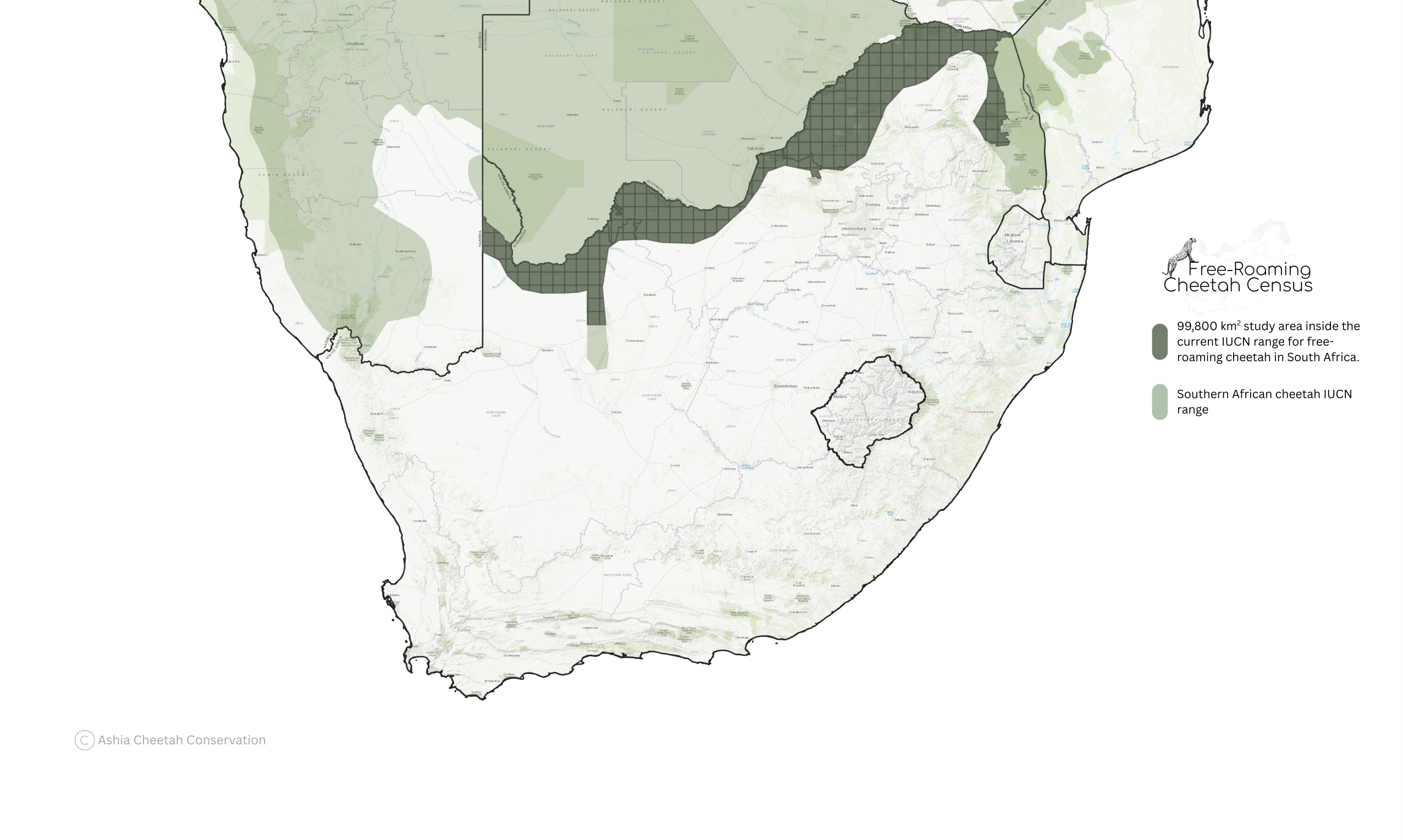
The Free-Roaming Cheetah Census (FRCC) was the first comprehensive empirical study conducted along South Africa’s northern borders – in the shrinking range of the last truly wild free-roaming cheetah. During the 3.5-year field work, close to 400 cameras collected more than 5.2 million high resolution images. Analysis of this vast dataset yielded a critically low count of just 119 individuals consisting of 83 mature adults and 36 cubs or subadults across the entire free-roaming census range.
The cheetah is designated as a legally protected species under South African biodiversity frameworks. However, the census findings revealed that protection on paper is not enough. With the data confirming a steep decline of at least 70% from previous population estimates, conserving South Africa’s last truly wild cheetah and the landscapes they depend on has never been more important.
The Free Roaming Cheetah Census report provides insights into the declining numbers, human-wildlife conflict and tolerance, dietary and genetic findings, cheetah use of the landscape, and observations from farmland areas. All supporting the reclassification of wild cheetah in South Africa to Endangered status.
After collecting more than 5.2 million camera-trap images, conducting 299 landowner and farmer surveys, tracking 20 collared cheetahs, and analysing over 100 opportunistically collected biological samples (blood and scat), the findings revealed these sobering insights:
The census identified a minimum of 83 adult cheetah in the vast study area that spans across three provinces. These numbers represent a 70% decline from estimates made in 2017.
Perceived cheetah presence and conflict did not always align with the objective data from camera traps, tracking data and cheetah scat analysis. Notable, no livestock – including cattle, goats, sheep or chicken – were detected in any analysed scat samples confirmed to originate from cheetah. This highlights the importance of combining perceptions with empirical evidence, as cheetah presence and their believed impact on the landscape may at at times be overestimated.
The South African free-roaming population has separated into two seemingly unconnected sub-populations. The high human population density between Mahikeng in North West, South Africa and Gabarone, Botswana acts as an artificial barrier, preventing natural cheetah dispersal between the Kalahari population and the Limpopo population. Along with differing land-use, impermeable fencing and dense human settlements, these populations are headed towards ever-increasing isolation and potential inbreeding.
Significant genetic differences in long-living mammals, like the cheetah, often become detectable only after several generations. Given a cheetah generation time of 4 – 6 years, this suggests measurable genetic structuring may lag behind fragmentation by several decades. Analysis of blood samples taken between 2022 and 2025, along with archived biobank samples from SANBI, indicate that until recently, the two subpopulations had experienced some genetic connection. However, as indicated, movement between the regions is increasingly restricted, creating conditions of limited to no genetic exchange and isolation.
This census was a partnership between Ashia Cheetah Conservation (ACC) who largely funded the census, coordinated the surveys, provided staff for field work and ensured results were written up in a formal report, Cheetah Outreach Trust who managed all cheetah capture efforts, and assisted with surveys and field work when possible, and the University of Groningen who provided a PhD student for data analysis and some field work.